The Spirit of the Lord Will Not Always Strive with Man

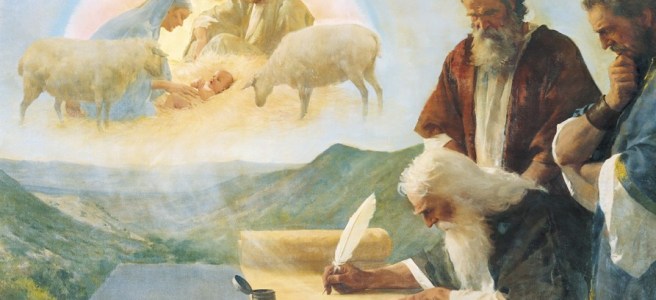
Nephi sees (through a prophetic vision given to him from the Lord) that, after falling into deep wickedness, many of his people in the Americas would be destroyed at the time of Christ’s death and resurrection (around A.D. 33-34). After being visited by Christ in person, three generations would pass away in peace and righteousness before wickedness and destruction would again afflict his people. Nephi identifies the loss of the Spirit as the reason for his people’s fall.

“…The Son of Righteousness shall appear unto them; and he shall heal them, and they shall have peace with him, until three generations shall have passed away, and many of the fourth generation shall have passed away in righteousness. And when these things have passed away a speedy destruction cometh unto my people; for, notwithstanding the pains of my soul, I have seen it; wherefore, I know that it shall come to pass; and they sell themselves for naught; for, for the reward of their pride and their foolishness they shall reap destruction; for because they yield unto the devil and choose works of darkness rather than light, therefore they must go down to hell. For the Spirit of the Lord will not always strive with man. And when the Spirit ceaseth to strive with man then cometh speedy destruction…” (2 Nephi 26:9-11)

Questions:

-Why do individuals choose darkness rather than light? Why do whole societies, such as the Nephites did, fall into a general pattern of prideful behavior and sin?

-How and when do things get to the point where the Spirit completely withdraws from a distinct group of people?

-Is it possible for a group or society that hasn’t received the fullness of God’s law to reach such a state where they reap destruction based on their rejection of God’s Spirit?

-Is it ever too late to turn back to God as an individual (even within a society that is headed the opposite direction)?

Ye May Liken Them unto You and unto All Men

Before recording many of the words of Isaiah onto the Gold Plates (from which the Book of Mormon was translated), Nephi testifies that Isaiah’s teachings and prophecies have such a sweeping spiritual vision that they are applicable to all people.

“And now I write some of the words of Isaiah, that whoso of my people shall see these words may lift up their hearts and rejoice for all men. Now these are the words, and ye may liken them unto you and unto all men.” (2 Nephi 11:8)

Below is a sampling of the writings of Isaiah as recorded by Nephi:

“…Let us go up to the mountain of the Lord, to the house of the God of Jacob; and he will teach us of his ways, and we will walk in his paths.” (2 Nephi 12:3Map of the Temples of the Church of Jesus Christ of Latter-day Saints)

“O ye wicked ones, enter into the rock, and hide thee in the dust, for the fear of the Lord and the glory of his majesty shall smite thee. And it shall come to pass that the lofty looks of man shall be humbled, and the haughtiness of men shall be bowed down, and the Lord alone shall be exalted in that day. For the day of the Lord of Hosts soon cometh upon all nations, yea, upon every one; yea, upon the proud and lofty and upon every one who is lifted up, and he shall be brought low.” (2 Nephi 12:10-12Second Coming)

“…The idols he shall utterly abolish. And they shall go into the holes of the rocks, and into the caves of the earth, for the fear of the Lord shall come upon them and the glory of his majesty shall smite them, when he ariseth to shake terribly the earth. In that day a man shall cast his idols of silver, and his idols of gold, which he hath made for himself to worship, to the moles and to the bats; To go into the clefts of the rocks, and into the tops of the ragged rocks, for the fear of the Lord shall come upon them and the majesty of his glory shall smite them, when he ariseth to shake terribly the earth.” (2 Nephi 12:18-21Second Coming)

“Cease ye from man, whose breath is in his nostrils; for wherein is he to be accounted of?” (2 Nephi 12:22Worldliness)

“Say unto the righteous that is it well with them; for they shall eat the fruit of their doings. Wo unto the wicked for they shall perish; for the reward of their hands shall be upon them!” (2 Nephi 13:10-11All Men Come unto God to Be Judged of Him)

“In that day shall the branch of the Lord be beautiful and glorious; the fruit of the earth excellent and comely to them that are escaped of Israel. And it shall come to pass, they that are left in Zion and remain in Jerusalem shall be called holy, every one that is written among the living in Jerusalem…” (2 Nephi 14:2-3Millennium)

“…They regard not the work of the Lord, neither consider the operation of his hnds. Therefore, my people are gone into captivity, because they have no knowledge…Therefore hell hath enlarged herself, and opened her mouth without measure; and their glory, and their multitude, and their pomp, and he that rejoiceth, shall descend into it” (2 Nephi 15:12-14Cursed is He Who Putteth His Trust in Man)

“Wo unto them that draw iniquity with cords of vanity, and sin as it were with a cart rope.” (2 Nephi 15:18Sin)

“Wo unto them that call evil good, and good evil, that put darkness for light, and light for darkness, that put bitter for sweet, and sweet for bitter!” (2 Nephi 15:20Deception)

“Wo unto the wise in their own eyes and prudent in their own sight!” (2 Nephi 15:21Pride)

“Wo unto the mighty to drink wine, and men of strength to mingle strong drink.” (2 Nephi 15:22Word of Wisdom)

“…As the fire devoureth the stubble, and the flame consumeth the chaff, their root shall be rottenness, and their blossoms shall go up as dust; because they have cast away the law of the Lord of Hosts, and despised the word of the Holy One of Israel.” (2 Nephi 15:24The Wisdom and Praise of the World is Foolishness before God)

“…His hand is stretched out still.” (2 Nephi 15:25Mercy)

“Sanctify the Lord of Hosts himself, and let him be your fear, and let him be your dread.” (2 Nephi 18:13Fear)

“Wo be unto them that decree unrighteous decrees, and that write grievousness which they have prescribed; To turn away the needy from judgment, and to take away the right from the poor of my people, that widows may be their prey, and that they may rob the fatherless.” (2 Nephi 20:1-2 —  Unrighteousness)

“They shall not hurt nor destroy in all my holy mountain, for the earth shall be full of the knowledge of the Lord, as the waters cover the sea.” (2 Nephi 21:9Millennium)

“The Lord shall set his hand again the second time to recover the remnant of his people which shall be left, from Assyria, and from Egypt, and from Pathros, and from Cush, and from Elam, and from Shinar, and from Hamath and from the islands of the sea. And he shall set up an ensign for the nations, and shall assemble the outcasts of Israel, and gather together the dispersed of Judah from the four corners of the earth. The envy of Ephraim also shall depart, and the adversaries of Judah shall be cut off; Ephraim shall not envy Judah, and Judah shall not vex Ephraim.” (2 Nephi 21:11-13Gathering of Israel)

Sing unto the Lord; for he hath done excellent things…” (2 Nephi 22:5Sing)

“…Mine anger is not upon them that rejoice in my highness.” (2 Nephi 23:3Worship)

“And it shall come to pass in that day that the Lord shall give thee rest, from thy sorrow, and from thy fear, and from the hard bondage wherein thou wast made to serve.” (2 Nephi 24:3MillenniumHouse of Israel)

I Will Fulfil My Promises Which I Have Made unto the Children of Men

God, through his prophet Jacob, speaks concerning the inevitable fulfillment of His covenants in the last days. Spiritual darkness and destruction will follow those who fight against God as he fulfills His promises to gather the righteous to Zion.

“…That my covenants may be fulfilled which I have made unto the children of men, that I will do unto them while they are in the flesh, I must needs destroy the secret works of darkness, and of murders, and of abominations. Wherefore, he that fighteth against Zion, both Jew and Gentile, both bond and free, both male and female, shall perish; for they are they who are the whore of all the earth; for they who are not for me are against me, saith our God. For I will fulfil my promises which I have made unto the children of men, that I will do unto them while they are in the flesh.” (2 Nephi 10:15-17)

Questions:

-Based on this passage: How is understanding the covenants God has made, and how He will fulfill them in the last days, key to knowing whether you are in line with God’s will?

-If a person does not understand what God is doing, would it be easier for him or her to be drawn into a position where he or she is fighting against His work?

The Descendants of the Lehi Will Become a Righteous Branch of the House of Israel

Jacob reiterates God’s promise, also given to his brother Nephi, that his father’s descendants in the Americas will again receive the peace and strength of the restored Gospel (after a time of apostasy, great trials, and destruction).

“…Behold how great the covenants of the Lord, and how great his condescensions unto the children of men; and because of his greatness and his grace and mercy, he has promised unto us that our seed shall not utterly be destroyed, according to the flesh, but that he would preserve them; and in future generations they shall become a righteous branch unto the house of Israel.” (2 Nephi 9:53)

Questions:

-Do you believe that God cares deeply enough about the righteous desires of his children on earth, that He would promise to fulfill them (as He did in the case of Lehi’s family and others in ancient times regarding their descendants)?

-Can you enter into a covenant relationship with God wherein He promises to care for and bless your posterity (to the degree they will let Him)? What about a covenant relationship related to other righteous desires of your heart?

-How would you know God had accepted the covenant? How would you know what God’s specific promises are and what your specific obligations are?

-Is there a church now in existence through which God makes such covenant relationships and makes the related blessings and obligations clear? If so, how did God give the priesthood of this church the authority to officiate the covenant relationships in His name?

-Are the descendants of Lehi becoming a righteous branch of Israel now? Are they largely awake to the covenant blessings that have been established for them? Or, is the awakening still in its early stages?

The Righteous Love the Truth and Are Not Shaken

Jacob realizes his teachings about…

…are going to be hard for some to hear.

This being the case, he pleads with those who hear these messages not to rebel against the truth but to reconcile themselves with God through the Atonement of Jesus Christ.

“…Give ear to my words. Remember the greatness of the Holy One of Israel. Do not say that I have spoken hard things against you; for if you do ye will revile against the truth; for I have spoken the words of your Maker. I know the words of truth are hard against all uncleanness; but the righteous fear them not, for they love the truth and are not shaken. O then my beloved [brothers and sisters] come unto the Lord, the Holy One. Remember that his paths are righteous. Behold, the way for man is narrow, but it lieth in a straight course before him, and the keeper of the gate is the Holy One of Israel; and he employeth no servant there; and there is none other way save it be by the gate; for he cannot be deceived, for the Lord God is his name.” (2 Nephi 9:40-41)

Questions:

-How easy is it for most people to perceive and accept the greatness of God, and His righteous standards, in relation to their shortcomings and sins?

-Do many feel it is easier to avoid facing the unclean aspects of their lives in relation to God than it is to square up to the truth of the situation and ask God for help to become clean through His power?

-Are many of the ideas and philosophies of the world popular because they help people avoid facing God and the uncomfortable aspects of seeking forgiveness?

-Is being willing to face one’s uncleanness, and work with God to remedy the situation, one of the main aspects of what Jacob calls righteousness? Would a person who continually strives to recognize their weaknesses, and do this work of repentance, be prone to judge others harshly who have similar mortal frailties? Is it impossible to be righteous and self-righteous at the same time?

-Will anyone be able to hide from the reality of his or her relationship with God at the time of the Resurrection and the Day of Judgment?

They Must be Judged According to the Holy Judgment of God

Jacob recounts how the Resurrection occurs prior to the Final Judgment and how these two events solidify each soul’s status in relation to God for eternity.

“…When all men shall have passed from this first death unto life, insomuch as they have become immortal, they must appear before the judgment-seat of the Holy One of Israel; and then cometh the judgment, and then must they be judged according to the holy judgment of God. And assuredly, as the Lord liveth, for the Lord God hath spoken it, and it is his eternal word, which cannot pass away, that they who are righteous shall be righteous still, and they who are filthy shall be filthy still; wherefore, they who are filthy are the devil and his angels; and they shall go away into everlasting fire, prepared for them; and their torment is as a lake of fire and brimstone, whose flame ascendeth up forever and ever and has no end. O the greatness and the justice of our God! For he executeth all his words, and they have gone forth out of his mouth, and his law must be fulfilled.” (2 Nephi 9:15-17)

Questions:

-How generous and loving will Christ be as our Eternal Judge? How willing will He be to extend mercy in whatever ways He can based on the choices we made in relation to God’s law? Could those who never had a chance to receive God’s law during their time in mortality be judged by that law?

-How fortunate will we be to have Christ both as our Judge and our Mediator? (See quote by Jeffrey Holland below.)

-Do “the devil and his angels” that Jacob refers to in the passage above include not only those spirits who followed Satan in the premortal life but also those who, after initially following God’s plan by coming to earth to receive a mortal body, then stubbornly reject the mercy He has extended to them—even after receiving a sure witness from the Holy Ghost of what Christ has done for them in appeasing the law of eternal justice (see sons of Perdition)? Will everyone else—those who are not rebellious and receive Christ’s mercy as they come to understand it—receive at least some Degree of Glory?

-Why will those who are eternally filthy experience torment that is like a “lake of fire and brimstone?”

-Is the Final Judgment also a “Final Chance” to receive Christ’s mercy before all who reject Him are sent away eternally? How important is it to seek Christ’s mercy through repentance now rather than denying the power of His grace until the Final Judgment?

Teachings of Latter-day Prophets, Seers, and Revelators:

“As ‘Wonderful Counselor,’ he will be our mediator, our intercessor, defending our cause in the courts of heaven. …

“Of course, as noted by Isaiah, Christ is not only a mediator but also a judge [see Mosiah 3:10; Moroni 10:34; Moses 6:57]. It is in that role of judge that we may find even greater meaning in Abinadi’s repeated expression that ‘God himself’ will come down to redeem his people [Mosiah 13:28; see also Mosiah 13:34; 15:1; Alma 42:15]. It is as if the judge in that great courtroom in heaven, unwilling to ask anyone but himself to bear the burdens of the guilty people standing in the dock, takes off his judicial robes and comes down to earth to bear their stripes personally. Christ as merciful judge is as beautiful and wonderful a concept as that of Christ as counselor, mediator, and advocate.” (Jeffrey R. Holland, Christ and the New Covenant, 80–81)

O How Great the Plan of Our God!

Jacob continues to teach about the power of Christ’s Atonement. Even the terrible grip on those who experience the combination of physical death (the grave) and spiritual death (hell) will be loosened by Christ’s power of resurrection

O how great the goodness of our God, who prepareth a way for our escape from the grasp of this awful monster; yea, that monster, death and hell, which I call the death of the body, and also the death of the spirit. And because of the way of deliverance of our God, the Holy One of Israel, this death, of which I have spoken, which is the temporal, shall deliver up its dead; which death is the grave. And this death of which I have spoken, which is the spiritual death shall deliver up its dead; which spiritual death is hell; wherefore death and hell must deliver up their dead, and hell must deliver up its captive spirits, and the grave must deliver up its captive bodies, and the bodies and the spirits of men will be restored one to the other; and it is by the power of the resurrection of the Holy One of Israel.” (2 Nephi 9:10-12)

…And those who have experienced physical death in the hope of Christ, who have overcome spiritual death through the power of His righteousness, will rise from the grave with immeasurable joy.

“O how great the plan of our God! For on the other hand, the paradise of God must deliver up the spirits of the righteous, and the grave deliver up the body of the righteous; and the spirit and the body is restored to itself again, and all men become incorruptible, and immortal, and they are living souls, having a perfect knowledge like unto us in the flesh, save it be that our knowledge shall be perfect. Wherefore, we shall have a perfect knowledge of all our guilt, and our uncleanness, and our nakedness; and the righteous shall have a perfect knowledge of their enjoyment, and their righteousness, being clothed with purity, yea even with the robe of righteousness.” (2 Nephi 9:13-14)

Questions:

-Why does Jacob refer to the combination of the death of the body and the death of the spirit as being monstrous?

-What is the paradise of God that Jacob is referring to when describing what the righteous will experience prior to the Resurrection?

-Can anyone be clothed with purity and wear the robe of righteousness except through the power of Jesus Christ’s Atonement?

-Is anyone truly alive without their physical body? How much more alive will we be when blessed with an incorruptible and immortal body? How much more will we be alive to who we are spiritually?

Teachings of Latter-day Prophets, Seers, and Revelators:

“Thanks be to God for the wonder and the majesty of His eternal plan. Thank and glorify His Beloved Son, who, with indescribable suffering, gave His life on Calvary’s cross to pay the debt of mortal sin. He it was who, through His atoning sacrifice, broke the bonds of death and with godly power rose triumphant from the tomb. He is our Redeemer, the Redeemer of all mankind. He is the Savior of the world. He is the Son of God, the Author of our salvation” (Gordon B. Hinckley, “The Victory over Death,” Ensign, May 1985, 51).

“Just as a man does not really desire food until he is hungry, so he does not desire the salvation of Christ until he knows why he needs Christ.

“No one adequately and properly knows why he needs Christ until he understands and accepts the doctrine of the Fall and its effect upon all mankind. And no other book in the world explains this vital doctrine nearly as well as the Book of Mormon” (Ezra Taft Benson, “The Book of Mormon and the Doctrine and Covenants,” Ensign, May 1987, 85).

“The Apostle Peter referred to the fact that God the Father, in His abundant mercy, ‘hath begotten us again unto a lively hope by the resurrection of Jesus Christ from the dead’ (1 Pet. 1:3; see also 1 Thes. 4:13–18).

“The ‘lively hope’ we are given by the resurrection is our conviction that death is not the conclusion of our identity but merely a necessary step in the destined transition from mortality to immortality. This hope changes the whole perspective of mortal life. …

“The assurance of resurrection gives us the strength and perspective to endure the mortal challenges faced by each of us and by those we love, such things as the physical, mental, or emotional deficiencies we bring with us at birth or acquire during mortal life. Because of the resurrection, we know that these mortal deficiencies are only temporary!

“The assurance of resurrection also gives us a powerful incentive to keep the commandments of God during our mortal lives. …

“Our sure knowledge of a resurrection to immortality also gives us the courage to face our own death—even a death that we might call premature. …

“The assurance of immortality also helps us bear the mortal separations involved in the death of our loved ones. … We should all praise God for the assured resurrection that makes our mortal separations temporary and gives us the hope and strength to carry on” (Dallin H. Oaks, “Resurrection,” Ensign, May 2000, 15–16).

If There Be No Righteousness There Be No Happiness

Lehi teaches his son, Jacob, about the power of God’s law to create meaning through consequence and how all things witness there is a God.

“…If ye shall say there is no law, ye shall also say there is no sin. If ye say there is no sin, ye shall also say there is no righteousness. And if there be no righteousness there be no happiness. And if there be no righteousness nor happiness there be no punishment nor misery. And if these things are not there is no God. And if there is no God we are not, neither the earth; for there could have been no creation of things, neither to act nor to be acted upon; wherefore, all things must have vanished away.” (2 Nephi 2:13)

-Do you believe sin is real?

How meaningful would life be without consequences?

-Do the most lasting consequences occur in this life? Or, do they occur when each individual is brought back to God’s presence to be judged?

-How is righteousness tied to happiness?

Teachings of Latter-day Prophets, Seers, and Revelators:

“Happiness comes of righteousness. ‘Wickedness never was happiness.’ (Alma 41:10.) Sin never was happiness. Selfishness never was happiness. Greed never was happiness. Happiness lies in living the principles of the gospel of Jesus Christ” (Gordon B. Hinckley, in “Fast-Paced Schedule for the Prophet: Meets with Young Adults, Youth in Three Meetings in Colorado,” Church News, Apr. 20, 1996, 3).

There Must Be Opposition in All Things

Lehi teaches his son, Jacob, about how life’s difficulties signify and create meaning in human choice:

“…It must be, that there is an opposition in all things. If not so…righteousness could not be brought to pass, neither wickedness, neither holiness nor misery, neither good nor bad. Wherefore, all things must needs be a compound in one; wherefore, if it should be one body it must needs remain dead, having no life neither death, nor corruption nor incorruption, happiness nor misery, neither sense nor insensibility.” (2 Nephi 2:11)

-Is it accurate to say that life can be deeply difficult and deeply rewarding?

-Do you believe God has given us a deeply meaningful challenge in giving us mortal life?

-Is it possible to view earthly trials as a means to greater refinement, rather than as arbitrary setbacks?

The Spirit Is the Same, Yesterday, Today, and Forever

As he recounts (somewhere around 588-570 B.C.) how his son Jacob had come to know Christ, Lehi focuses on the power and consistency of the Spirit, who is the third member of the Godhead, in testifying of Christ.

“…I know that thou art redeemed, because of the righteousness of thy Redeemer; for thou hast beheld that in the fulness of time he cometh to bring salvation unto men. And thou hast beheld in thy youth his glory; wherefore, thou art blessed even as they unto whom he shall minister in the flesh; for the Spirit is the same, yesterday, today, and forever.” (2 Nephi 2:3-4)

-Did the Spirit have the power to testify of Christ in ancient times, before He came to the earth? Was the Spirit’s testimony in any way vague or indirect? Or, was it a clear manifestation without ambiguity?

-Did the power of the manifestation depend on the faithfulness and spiritual strength of the individual to whom the witness came?

-Is it possible for us, who live after Christ’s coming, to receive a clear manifestation, without ambiguity, that He was (and is) who He said he was?