There Are Two Churches Only

In teaching Nephi about the events of the last days, and the great division that will occur between those who serve the Lamb of God and those who reject Him (See The Lamb of God Will Work a Great and Marvelous Work), the angel of the Lord explains to Nephi that ultimately there are only two churches.

“And [the angel] said unto me: Behold there are two churches only; the one is the church of the Lamb of God, and the other is the church of the devil; wherefore, whoso belongeth not to the church of the Lamb of God belongeth to that great church, which is the mother of abominations; and she is the whore of all the earth.” (1 Nephi 14:10)

-If God has set Himself to test the hearts of all people in our time (as discussed in the post previous to this one—see The Lamb of God Will Work a Great and Marvelous Work), will the division between the church of the Lamb of God and the church of the devil become more distinct and recognizable than ever? In this scenario of clarification, how powerful would the draw of the work of the Lamb of God be to all good and sincere people (of all faiths and denominations) as the distinction unfolds and the true destructiveness and evil of the church of the devil is revealed?

Video from Book of Mormon Central:

Latter-day Prophets, Seers and Revelators:

The following was declared in an 1845 proclamation from the Twelve Apostles of the Church of Jesus Christ of Latter-day Saints: “As this work progresses in its onward course, and becomes more and more an object of political and religious interest and excitement, no king, ruler or subject, no community or individual, will stand neutral. All will at length be influenced by one spirit or the other; and all will take sides either for or against the Kingdom of God, and the fulfillment of the prophets, in the great restoration and return of his long dispersed covenant people” (in Conference Report, Apr. 1980, p. 46; or Ensign, May 1980, p. 33).

The Lamb of God Will Work a Great and Marvelous Work—Either to the Convincing of Them unto Peace and Life Eternal or unto the Deliverance of Them to the Hardness of their Hearts

Nephi continues to be taught about the events of the last days.

“…The angel spake unto me, Nephi, saying: Thou hast beheld that if the Gentiles repent it shall be well with them…and thou also hast heard that whoso repenteth not must perish. Therefore, wo be unto the Gentiles if it so be that they harden their hearts against the Lamb of God. For the time cometh, saith the Lamb of God, that I will work a great and marvelous work among the children of men; a work which shall be everlasting, either on the one had or the other—either to the convincing of them unto peace and life eternal, or unto the deliverance of them to the hardness of their hearts and the blindness of their minds unto their being brought down into captivity and also into destruction, both temporally and spiritually according to the captivity of the devil.” (1 Nephi 14:5-7)

-What does it mean to repent? And, according to the passage above, how important is repentance for the temporal and spiritual welfare of the Gentiles?

-Does this message only apply to the Gentiles? Or, is it applicable to everyone?

-Are there signs of God’s great and marvelous work occurring now?

-Is your heart open to the Lamb of God and the work He is performing to bring peace and life eternal to all who will receive Him?

Prophets, Seers, and Revelators

“As this work [of the Church of Jesus Christ of Latter-day Saints] progresses in its onward course, and becomes more and more an object of political and religious interest and excitement, no king, ruler, or subject, no community or individual, will stand neutral. All will at length be influenced by one spirit or the other; and will take sides either for or against the kingdom of God” (in James R. Clark, comp., Messages of the First Presidency of The Church of Jesus Christ of Latter-day Saints [1965], 1:257)

That Great Pit Which Has Been Dug for the Destruction of Men Shall Be Filled by Those Who Dug It

Nephi continues to be taught, by an angel of the Lord, about events leading up to Christ’s second coming. He learns that the Gentiles in the Americas, and throughout the entire world, who receive Christ’s latter-day revelations and directions will inherit the covenant blessings of the house of Israel along with those who are tied to the house of Israel by ancestry (see A Promised Land for All Who Serve the Lamb of God).

On the other hand, Nephi also learns that those who fight against Christ’s words and actions in the last days — when He is gathering the house of Israel according to the covenants made with them — will shut themselves outside the covenant blessings and, thus, will be vulnerable to the destructive pitfalls laid by Satan to capture souls in our time. The snares laid to fight against Christ and His followers will turn to the detriment and destruction of those who laid the snares.

“…That great pit, which hath been digged…by that great and abominable church, which was founded by the devil and his children, that he might lead away the souls of men down to hell—yea, that great pit which has been digged for the destruction of men shall be filled by those who digged it, unto their utter destruction, saith the Lamb of God…For behold, this is according to the captivity of the devil, and also according to the justice of God, upon all those who will work wickedness and abomination before him.” (1 Nephi 14:3-4)

Questions:

-When a person or group has ill will toward another person or group, who does it usually hurt the most in the long run? Is it the person or group with the malice? Or, the person or group toward which the malice is directed? How long will a group or society focused on fault finding and entrapment of others function before turning on its own members?

-What is the nature of the figurative pit mentioned in this prophecy? How will it be dug by those who wish to trap others within it?

-How difficult will it be to escape the pit? As Christ manifests Himself in word, power, and deed to restore the fulness of His gospel and gather the house of Israel (see 1 Nephi 14:2 and A Promised Land for All Who Serve the Lamb of God) will it be possible to stay neutral? Or, will “sitting on the fence” be more difficult than ever as a clear separation develops between those who recognize Christ’s work as real and those who deny it and fight against its progress? (See Christ’s parable of the wheat and the tares in Matthew 13:25-30.)

The Book of Mormon Is a Witness to the Truth of the Bible

As Nephi continues to be taught by an angel of the Lord, he receives additional knowledge about the destiny of the record that his people would keep in the Americas. He is shown that when the people of the Old World — who believed in and revered the Bible — came to the New World, they would receive a confirming testimony from the religious record kept by Nephi and his descendants who had lived centuries before in the New World: The testimonies of the Old and New World would come together and support each other in declaring that Jesus is the Savior.

“For behold saith the Lamb: I will manifest myself unto thy seed, that they shall write many things which I shall minister unto them, which shall be plain and precious; and after thy seed shall be destroyed, and dwindle in unbelief…these things shall be hid up, to come forth unto the Gentiles, by the gift and power of the Lamb. And in them shall be written my gospel, saith the Lamb, and my rock and salvation.

And the angel spake unto me saying: These last records, which thou hast seen among the Gentiles, shall establish the truth of the first…and shall make known to all kindreds, tongues, and people, that the Lamb of God is the Son of the Eternal Father, and the Savior of the world; and that all men must come unto him, or they cannot be saved. And they must come according to the words which shall be established by the mouth of the Lamb; and the words of the Lamb shall be made known in the records of thy seed, as well as in the records of the twelve apostles of the Lamb; wherefore they both shall be established in one; for there is one God and one Shepherd over all the earth.” (1 Nephi 13:35-36,40-41)

Questions:

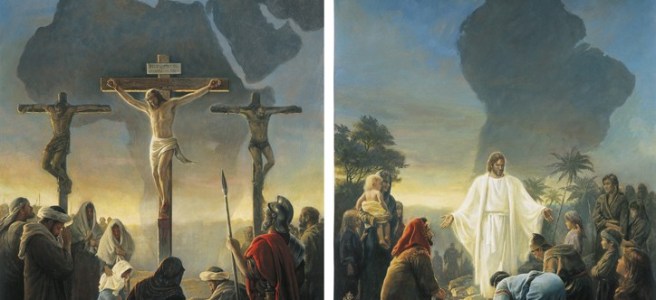
-Did Christ visit the Americas after His resurrection (see 3 Nephi 11)?

-In this time where atheistic worldviews are becoming increasingly popular, how valuable is the knowledge that God is still working to gather and bless those who would have Him to be their God? How valuable is it to have another scriptural witness that Jesus is the Savior of all the world?

-How hard do you think the adversary would work to defame and downplay a powerful second witness of Christ? How many people quickly dismiss the value of the Book of Mormon without personally studying it and asking God in prayer if it is from Him?

Teachings of Latter-day Prophets, Seers, and Revelators:

“Scriptural witnesses authenticate each other. This concept was explained long ago when a prophet wrote that the Book of Mormon was ‘written for the intent that ye may believe [the Bible]; and if ye believe [the Bible] ye will believe [the Book of Mormon] also’ [Mormon 7:9]. Each book refers to the other. Each book stands as evidence that God lives and speaks to His children by revelation to His prophets.

“Love for the Book of Mormon expands one’s love for the Bible and vice versa. Scriptures of the Restoration do not compete with the Bible; they complement the Bible” (“Scriptural Witnesses,” Ensign or Liahona, Nov. 2007, 43).

Teachings of the Seventies

“The Bible is one witness of Jesus Christ; the Book of Mormon is another. Why is this second witness so crucial? The following illustration may help: How many straight lines can you draw through a single point on a piece of paper? The answer is infinite. For a moment, suppose that single point represents the Bible and that hundreds of those straight lines drawn through that point represent different interpretations of the Bible and that each of those interpretations represents a different church.

“What happens, however, if on that piece of paper there is a second point representing the Book of Mormon? How many straight lines could you draw between these two reference points: the Bible and the Book of Mormon? Only one. Only one interpretation of Christ’s doctrines survives the testimony of these two witnesses.

“Again and again the Book of Mormon acts as a confirming, clarifying, unifying witness of the doctrines taught in the Bible so that there is only ‘one Lord, one faith, one baptism.’ For example, some people are confused as to whether baptism is essential for salvation even though the Savior declared to Nicodemus, ‘Except a man be born of water and of the Spirit, he cannot enter into the kingdom of God’ (John 3:5). The Book of Mormon, however, eliminates all doubt on that subject: ‘And he commandeth all men that they must repent, and be baptized in his name, … or they cannot be saved in the kingdom of God’ (2 Nephi 9:23).

“There exist various modes of baptisms in the world today even though the Bible tells us the manner in which the Savior, our great Exemplar, was baptized: ‘[He] went up straightway out of the water’ (Matthew 3:16). Could He have come up out of the water unless He first went down into the water? Lest there be any discord on this subject, the Book of Mormon dispels it with this straightforward statement of doctrine as to the proper manner of baptism: ‘And then shall ye immerse them in the water’ (3 Nephi 11:26). …

“The list of doctrinal confirmations and clarifications goes on and on, but none is more powerful nor poignant than the Book of Mormon’s discourses on the Atonement of Jesus Christ. Would you like to have emblazoned on your soul an undeniable witness that the Savior descended beneath your sins and that there is no sin, no mortal plight outside the merciful reach of His Atonement—that for each of your struggles He has a remedy of superior healing power? Then read the Book of Mormon. It will teach you and testify to you that Christ’s Atonement is infinite because it circumscribes and encompasses and transcends every finite frailty known to man. That is why the prophet Mormon declared, ‘Ye shall have hope through the atonement of Christ’ (Moroni 7:41)” (Tad R. Callister, “The Book of Mormon—a Book from God,” Ensign or Liahona, Nov. 2011, 75–76).

I Will Bring Forth unto Them, in My Own Power, Much of My Gospel

After Nephi is shown that many truths would be taken from the gospel record prior to the Bible coming to the Americas, he is also shown that God would reestablish these lost truths by His own power.

…Because of the many plain and precious things which have been taken out of the book…an exceedingly great many do stumble…insomuch that Satan hath great power over them. Nevertheless…God will not suffer that the Gentiles shall forever remain in that awful state of blindness…they are in because of the plain and most precious parts of the gospel of the Lamb which have been kept back by that abominable church…Behold, saith the Lamb of God, I will bring forth unto them, in my own power, much of my gospel, which shall be plain and precious.” (1 Nephi 13:29-30, 32-34)

Questions:

-Do you believe that the Book of Mormon was brought to us through Jesus Christ’s own power? Can you make a meaningful decision about your belief without carefully reading the book and seeking God’s guidance about its truth?

-If the Book of Mormon contains many plain and precious truths, brought to us through God’s direction and revelation (see Condemn not the Things of God), how important is it to read and understand?

– Was the coming forth of the Book of Mormon the culmination of social thought or the product of the most educated and sophisticated religious minds of its day (i.e., man’s power)? Or, was it by God’s power—through a commandment to ancient American prophets to keep a record and a commandment to a modern-day prophet to translate it by the power of revelation?

-Are there other books — besides the Book of Mormon — that have come to us in modern times, by God’s power, and have helped to restore plain and precious truths?

Latter-day Prophets, Seers, and Revelators

“The Book of Mormon is the keystone in our witness of Jesus Christ, who is Himself the cornerstone of everything we do. It bears witness of His reality with power and clarity. Unlike the Bible, which passed through generations of copyists, translators, and corrupt religionists who tampered with the text, the Book of Mormon came from writer to reader in just one inspired step of translation. Therefore, its testimony of the Master is clear, undiluted, and full of power. But it does even more. Much of the Christian world today rejects the divinity of the Savior. They question His miraculous birth, His perfect life, and the reality of His glorious resurrection. The Book of Mormon teaches in plain and unmistakable terms about the truth of all of those. It also provides the most complete explanation of the doctrine of the Atonement. Truly, this divinely inspired book is a keystone in bearing witness to the world that Jesus is the Christ” (Ezra Taft Benson, “The Book of Mormon—Keystone of Our Religion,” Ensign, Nov. 1986, 5).

“The Lord himself has stated that the Book of Mormon contains the ‘fulness of the gospel of Jesus Christ’ (Doctrine & Covenants 20:9). That does not mean it contains every teaching, every doctrine ever revealed. Rather, it means that in the Book of Mormon we will find the fulness of those doctrines required for our salvation. And they are taught plainly and simply so that even children can learn the ways of salvation and exaltation” (Ezra Taft Benson, “The Book of Mormon—Keystone of Our Religion,” Ensign, Nov. 1986, 6).


“The Book of Mormon is another testament of Christ. It restored precious truths concerning the Fall, the Atonement, the Resurrection, and life after death.

“Prior to the Restoration, the heavens had been closed for centuries. But with prophets and apostles upon the earth once more, the heavens were opened once again with visions and revelations. Many of the revelations that came to the Prophet Joseph Smith were written down in a book that came to be known as the Doctrine and Covenants. This contains further insights about principles and ordinances and is a valuable source concerning the structure of the priesthood. In addition, we have another canon of scripture called the Pearl of Great Price. It contains the book of Moses, which came by revelation to the Prophet Joseph Smith, and the book of Abraham, which he translated from a purchased Egyptian scroll. From these we learn not only a great deal more about Moses, Abraham, Enoch, and other prophets but also many more details about the Creation. We learn that the gospel of Jesus Christ was taught to all of the prophets from the beginning—even from the time of Adam” (James E. Faust, “The Restoration of All Things,” Ensign or Liahona, May 2006, 67–68).


“If…parents will read from the Book of Mormon prayerfully and regularly, both by themselves and with their children, the spirit of that great book will come to permeate our homes and all who dwell therein. The spirit of reverence will increase, mutual respect and consideration for each other will grow. The spirit of contention will depart. Parents will counsel their children in greater love and wisdom. Children will be more responsive and submissive to the counsel of their parents. Righteousness will increase. Faith, hope, and charity—the pure love of Christ—will abound in our homes and lives, bringing in their wake peace, joy, and happiness.” (Marion G. Romney, “The Book of Mormon,” Ensign, May 1980, 65-67)

They Have Taken Away from the Gospel of the Lamb Many Parts which are Plain and Most Precious

As Nephi continues to see future events through vision, he is shown by an angel how the gospel of Jesus Christ would be altered by the great and abominable church prior to the Bible coming to the Americas.

“Wherefore, these things go forth from the Jews in purity unto the Gentiles, according to the truth which is in God. And after they go forth by the hand of the twelve apostles of the Lamb, from the Jews unto the Gentiles, thou seest the formation of that great and abominable church, which is most abominable above all other churches; for behold, they have taken away from the gospel of the Lamb many parts which are plain and most precious; and also many covenants of the Lord have they taken away. And all this they have done that they might pervert the right ways of the Lord, that they might blind the eyes and harden the hearts of the children of men. Wherefore, thou seest that after the book hath gone forth through the hands of the great and abominable church, that there are many plain and precious things taken away from the book, which is the book of the Lamb of God.” (1 Nephi 13:25-28)

Questions:

-Is it possible for there to be a perfect book in a fallen world where men and women use imperfect written language to preserve texts?

-Would it surprise you if God allowed aspects of Christ’s teachings, the apostles’ teachings, and the words of the ancient prophets to be altered as described in the verses above? By what eternal principle would God withhold His intervention to stop such detrimental changes? Does God ever force those on the earth to do what is right? Or, does He always – as long as they are permitted by Him to live — allow them to show their true colors in relationship to His standards and righteousness?

-If you believe the angel’s declaration to Nephi that truths would be intentionally taken away from the gospel record, what plain and precious truths do you think may have been lost? Is there any way these truths can be (or have been) restored?

-Are there truths and covenants emphasized in the Book of Mormon that help reconstruct the full, undiminished gospel of Jesus Christ? How can you know the truth about this important question (see Moroni 10:3-5)?

Video from Book of Mormon Central:

The Great and Abominable Church

After the meaning of his father’s dream is revealed, Nephi continues to receive a prophetic vision through the Spirit and the help of an angel. He is shown that after the formation of Christ’s church another church would form in opposition to it:

“And the angel said unto me: Behold the formation of a church which is most abominable above all other churches, which slayeth the saints of God, yea, and tortureth them and bindeth them down, and yoketh them with a yoke of iron, and bringeth them down into captivity. And it came to pass that I beheld this great and abominable church; and I saw the devil that he was the founder of it…And the angel spake unto me, saying: Behold the gold, and the silver, and the silks, and the scarlets, and the fine-twined linen, and the precious clothing, and the harlots, are the desires of this great and abominable church. And also for the praise of the world do they destroy the saints of God, and bring them down into captivity.” (1 Nephi 13:5-6,8-9)

Questions:

-Does reference to the great and abominable church signify a specific, officially organized church? Or, does it signify a church that forms and functions spontaneously among all people due to the influence and deception of the devil?

-Would the abominable church be more active among societies and cultures that also have the fullness of Jesus Christ’s gospel established within them? Or, would it be better established among those societies and cultures that do not have a fullness of the gospel?

-What is the ultimate motivation of this great and abominable church? What do those who belong to it ultimately desire?

-Is destruction of those who are striving to serve God an indirect byproduct of the aims of the great and abominable church, which seeks the praise of the world? Or, is it a direct focus?

-Is it possible to be part of (or take some part in) the great and abominable church without realizing it?

-What are some safeguards you could employ to ensure you and your family are not drawn into participation with the great and abominable church?

-If its goal is popularity and the accumulation of material pleasures and things, how likely is this great and abominable church to have a strong influence over many media, advertising, and entertainment outlets?

Latter-day Prophets, Seers, and Revelators…

“The titles church of the devil and great and abominable church are used to identify all … organizations of whatever name or nature—whether political, philosophical, educational, economic, social, fraternal, civic, or religious—which are designed to take men on a course that leads away from God and his laws and thus from salvation in the kingdom of God” (Bruce R. McConkie, Mormon Doctrine, 2nd ed. [1966], 137–38).

The Bible is of Great Worth

As Nephi continues to have future events unfolded to him in vision, the angel describes the meaning of what Nephi is seeing. One portion of the vision focuses on the Bible coming to the Americas with the Europeans (Gentiles) who began emigrating from the 16th and 17th century onward.

“…And I beheld a book…carried forth among them. And the angel said unto me: Knowest thou the meaning of the book? And I said unto him: I know not. And he said: Behold it proceedeth out of the mouth of a Jew. And I, Nephi beheld it; and he said unto me: The book that thou beholdest is a record of the Jews, which contains the covenants of the Lord, which he hath made unto the house of Israel…wherefore, they are of great worth unto the Gentiles.” (1 Nephi 13:20-23)

Questions

Why did the angel emphasize the covenants made to the house of Israel as being a central aspect of the Bible’s value to the Gentiles? Could this emphasis be based on the fact that the Gentiles would be among (and mix with) many of the house of Israel in the Americas – including Lehi’s descendants – and that the two groups’ spiritual and physical prosperity (or lack thereof) would be closely tied together as the Lord fulfilled his covenants with the house of Israel?

What portion of the Bible, if any, was spoken or recorded by a non-Jew or non-Israelite? Are the most important passages, spoken directly by Jesus Christ himself, also from the mouth of a Man with a Jewish mother?

Does the new covenant which Jesus Christ established with His earthly ministry dissolve the covenants made to those who came before Him in any way (such as the covenants made to Abraham, Isaac, and Jacob)? Or, does the new covenant add to, and strengthen all the covenants that came before?

The Temptations of the Devil Blindeth Eyes and Hardeneth Hearts

While teaching Nephi about the meaning of his father’s dream, the Lord’s angel also teaches Nephi about the reality of Satan and his power to deceive.

“…The temptations of the devil…blindeth the eyes and hardeneth the hearts of the children of men, and leadeth them away into broad roads, that they perish and are lost.” (1 Nephi 12:17)

Questions:

-If you knew there was a being striving to keep all people on the earth in darkness and separated from God, would you be more careful about your thoughts, actions, and any easy acceptance of popular opinions?

-What does it take to rise above having one’s eyes blinded and heart hardened spiritually?

-What is the relationship between having a hardened heart and being spiritually blind?

-How can you keep your heart soft in your relationship with God and those around you?

-Are there thoughts you have empowered that are keeping you from feeling God’s love and kindness toward yourself and those around you?

The Multitudes of the Earth Fight Against the Apostles of the Lamb

The angel continues to teach Nephi about the meaning of his father’s dream, which had as one of its main elements a great and spacious building. Because of the unrelenting influence of Satan in the world, those who flow with general cultural currents will almost always end up aligning themselves against the apostles of Jesus Christ.

“…I saw the multitudes of the earth, that they were gathered together to fight against the apostles of the Lamb; for thus were the twelve called by the angel of the Lord. And the multitude of the earth was gathered together; and I beheld that they were in a large and spacious building, like unto the building which my father saw. And the angel of the Lord spake unto me again, saying: Behold the world and the wisdom thereof…And it came to pass that I saw and bear record that the great and spacious building was the pride of the world; and it fell, and the fall thereof was exceedingly great. And the angel of the Lord spake unto me again, saying: Thus shall be the destruction of all nations, kindreds, tongues, and people, that shall fight against the twelve apostles of the Lamb.” (1 Nephi 11:34-36)

In latter-day revelation, the Lord addresses those who fight against His servants:

“Cursed are all those that shall lift up the heel against my anointed…and cry they have sinned when they have not sinned before me, saith the Lord, but have done that which was meet in mine eyes, and which I commanded them. But those who cry transgression do it because they are the servants of sin and the children of disobedience themselves. And those who swear falsely against my servants…wo unto them; because they have offended my little ones they shall be severed from the ordinances of mine house. Their basket shall not be full…They shall not have right to the priesthood, nor their posterity after them from generation to generation” (Doctrine and Covenants 121:16-21).

Questions:

-Who were the twelve apostles who Christ called during his earthly ministry?

-Did the twelve stay the same? Or, where replacements called for those who died?

-Has there been a quorum of twelve apostles on the earth, without interruption since the time of Christ?

-Is there a church which has a quorum of twelve apostles today? If so, by whom were they called and from where do they derive their authority?

-How did those who did not accept or believe in the full gospel of Jesus Christ treat the original apostles?

-Would you expect apostles who were called in our time to be popular and accepted by the majority of people?

-How is pride related to whether a person (or group of people) fight against Christ’s apostles?

-If you came to know that Christ had called twelve apostles in our time, how important would it be for you to align yourself with these apostles rather than resisting their message and efforts?

Latter-day Prophets, Seers, and Revelators…

“To those of you who are inching your way closer and closer to that great and spacious building, let me make it completely clear that the people in that building have absolutely nothing to offer except instant, short-term gratification inescapably connected to long-term sorrow and suffering. The commandments you observe were not given by a dispassionate God to prevent you from having fun, but by a loving Father in Heaven who wants you to be happy while you are living on this earth as well as in the hereafter” (Elder Glen L. Pace, “They’re Not Really Happy,” Ensign, Nov. 1987, 40).