He Doeth Not Anything Save It Be for the Benefit of the World

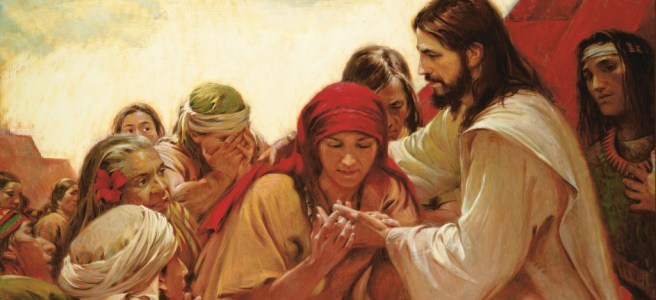
After describing the sin and secret combinations that would exist among the Gentiles in the last days (see previous post), Nephi teaches that Satan has promoted such things from the beginning to bring souls down into captivity. In contrast, Nephi gives insight into how and why the Lord does His work.

“The devil…is…the founder of murder, and works of darkness; yea, and he leadeth them by the neck with a flaxen cord, until he blindeth them with his strong cords forever. (2 Nephi 26:22)

For behold, my beloved brethren, I say unto you that the Lord God worketh not in darkness. He doeth not anything save it be for the benefit of the world; for he loveth the world, even that he layeth down his own life that he may draw all men unto him. Wherefore, he commandeth none that they shall not partake of his salvation. (2 Nephi 26:23)

Behold, doth he cry unto any, saying: Depart from me? Behold, I say unto you, Nay; but he saith: Come unto me all ye ends of the earth, buy milk and honey, without money and without price. Behold hath he commanded any that they should depart out of the synagogues, or out of the houses of worship? Behold I say unto you, Nay. Hath he commanded any that they should not partake of his salvation: Behold I say unto you, Nay; but he hath given it free for all men; and he hath commanded his people that they should persuade all men to repentance. Behold, hath the Lord commanded any that they should not partake of his goodness? Behold, I say unto you, Nay; but all men are privileged the one like unto the other, and none are forbidden.” (2 Nephi 26:24-28)

Questions:

-Does the devil have anything good to offer? Is there any limit to his hatred and ill-will towards every living soul on the earth?

-Is it even possible to comprehend the extent of the goodness God has to offer? Is there any limit to His love and generosity toward every living soul on the earth? Are we doing God’s will if we don’t strive to extend the same kind of love towards others?

-How many in the world see repentance as a way to embrace the goodness that God has to offer and reject the destructive aims of Satan?

Teachings of Latter-day Prophets, Seers, and Revelators:

“I hope that we welcome and love all of God’s children, including those who might dress, look, speak, or just do things differently. It is not good to make others feel as though they are deficient. Let us lift those around us. Let us extend a welcoming hand. Let us bestow upon our brothers and sisters in the Church a special measure of humanity, compassion, and charity so that they feel, at long last, they have finally found home. …

“It seems only right and proper that we extend to others that which we so earnestly desire for ourselves.

“I am not suggesting that we accept sin or overlook evil, in our personal life or in the world. Nevertheless, in our zeal, we sometimes confuse sin with sinner, and we condemn too quickly and with too little compassion. …

“… Let our hearts and hands be stretched out in compassion toward others, for everyone is walking his or her own difficult path” (Dieter F. Uchtdorf, “You Are My Hands,” Ensign or Liahona, May 2010, 68–69).
 

Jesus is the Christ, the Eternal God

Nephi reemphasizes that his record (and the records of the Nephite prophets who would follow him) is intended to be a testament of Jesus Christ to both Jew and Gentile, wherever they might live across the entire earth.

“…As I spake concerning the convincing of the Jews that Jesus is the very Christ, it must needs be that the Gentiles be convinced also that Jesus is the Christ, the Eternal God; And that he manifesteth himself unto all those who believe in him, by the power of the Holy Ghost; yea, unto every nation, kindred, tongue, and people, working mighty miracles, signs, and wonders, among the children of men according to their faith.” (2 Nephi 26:12-13)

Questions:

-How does Christ work with the Holy Ghost to manifest Himself to those who believe in him?

-Does the passage above suggest that the effort to believe needs to be exercised before the witness of the Holy Ghost will come?

-Are mighty miracles, signs, and wonders occurring among those who have steadfast faith in Christ?

Worship Him with All Your Might, Mind, and Strength, and Your Whole Soul

The Nephites practiced the law of Moses, but Nephi perceived that his people could easily lose track of the purpose of the law, which was to point their minds and hearts to the promised Messiah, Jesus Christ. After teaching that Christ was the only way by which a man or woman could be reconciled to God, Nephi cautions his people that they will be responsible for this clear knowledge he had given them.

“…The words which I have spoken shall stand as a testimony against you; for they are sufficient to teach any man the right way; for the right way is to believe in Christ and deny him not; for by denying him ye also deny the prophets and the law. And now behold, I say unto you that the right way is to believe in Christ, and deny him not; and Christ is the Holy One of Israel; wherefore, ye must bow down before him, and worship him with all your might, mind, and strength, and your whole soul; and if ye do this ye shall in nowise be cast out.” (2 Nephi 25:28-29)

Questions:

-What does it mean to worship Christ with all of one’s might, mind, and strength? What does it mean to worship Him with all of one’s soul?

-In our time where expression of the self, in almost any form, is celebrated and narcissistic individualism is a common value, how many people are willing to bow down to God?

-Does Nephi present whole-hearted devotion to Christ as a nice ideal? Or, does he present it as a spiritual necessity?

Teachings of the Seventy:

“Prophets across the ages have encouraged us and even implored us to believe in Christ. … The decision to believe is the most important choice we ever make. It shapes all our other decisions. …

“Belief and testimony and faith are not passive principles. They do not just happen to us. Belief is something we choose—we hope for it, we work for it, and we sacrifice for it. We will not accidentally come to believe in the Savior and His gospel any more than we will accidentally pray or pay tithing. We actively choose to believe, just like we choose to keep other commandments” (L. Whitney Clayton, “Choose to Believe,” Ensign or Liahona, May 2015, 38).

The Nations Who Shall Possess Them Shall Be Judged of Them

Nephi obtained a promise from the Lord that his record would be preserved for as long as the earth exists. Those who have access to his record and teachings will be held accountable for what they do with them.

“…The Lord God promised unto me that these things which I write shall be kept and preserved, and handed down unto my seed, from generation to generation, that the promise may be fulfilled unto Joseph, that his seed should never perish as long as the earth should stand. Wherefore, these things shall go from generation to generation as long as the earth shall stand; and they shall go according to the will and pleasure of God; and the nations who shall possess them shall be judged of them according to the words which are written.” (2 Nephi 25:21-22)

Questions:

-Which nations possess the record of the Nephite prophets as initiated by Nephi (a large portion of which is found in the Book of Mormon)?

-Is it at all intimidating to know that you will be responsible, in God’s eyes, for what you do with the truths found in the Book of Mormon?

-Do you think the blessing of having the light and knowledge contained in the Book of Mormon is worth the added responsibility?

-Are most, or all, true covenants with God tied to covenants he has made with others who have gone before (such as how promises received by Nephi were tied to the promises Joseph received)?

Teachings of Prophets, Seers, and Revelators:

“…Note where the Lord placed [The Book of Mormon’s] coming forth in the timetable of the unfolding Restoration. The only thing that preceded it was the First Vision. In that marvelous manifestation, the Prophet Joseph Smith learned the true nature of God and that God had a work for him to do. The coming forth of the Book of Mormon was the next thing to follow. Think of that in terms of what it implies. The coming forth of the Book of Mormon preceded the restoration of the priesthood. It was published just a few days before the Church was organized. The Saints were given the Book of Mormon to read before they were given the revelations outlining such great doctrines as the three degrees of glory, celestial marriage, or work for the dead. It came before priesthood quorums and Church organization. Doesn’t this tell us something about how the Lord views this sacred work?” (Ezra Taft Benson, “The Book of Mormon—Keystone of Our Religion,” Ensign, Nov. 1986, 4).

“…We must make the Book of Mormon a center focus of study…it was written for our day. The Nephites never had the book; neither did the Lamanites of ancient times. It was meant for us. Mormon wrote near the end of the Nephite civilization. Under the inspiration of God, who sees all things from the beginning, he abridged centuries of records, choosing the stories, speeches, and events that would be most helpful to us.

Each of the major writers of the Book of Mormon testified that he wrote for future generations. Nephi said: ‘The Lord God promised unto me that these things which I write shall be kept and preserved, and handed down unto my seed, from generation to generation’ (2 Ne. 25:21). His brother Jacob, who succeeded him, wrote similar words: ‘For [Nephi] said that the history of his people should be engraven upon his other plates, and that I should preserve these plates and hand them down unto my seed, from generation to generation’ (Jacob 1:3). Enos and Jarom both indicated that they too were writing not for their own peoples but for future generations (see Enos 1:15–16, Jarom 1:2).

Mormon himself said, ‘Yea, I speak unto you, ye remnant of the house of Israel’ (Morm. 7:1). And Moroni, the last of the inspired writers, actually saw our day and time. ‘Behold,’ he said, ‘the Lord hath shown unto me great and marvelous things concerning that which must shortly come, at that day when these things shall come forth among you.

‘Behold, I speak unto you as if ye were present, and yet ye are not. But behold, Jesus Christ hath shown you unto me, and I know your doing’ (Morm. 8:34–35).

If they saw our day and chose those things which would be of greatest worth to us, is not that how we should study the Book of Mormon? We should constantly ask ourselves, “Why did the Lord inspire Mormon (or Moroni or Alma) to include that in his record? What lesson can I learn from that to help me live in this day and age?” (Ezra Taft Benson, “The Book of Mormon—Keystone of Our Religion,” Ensign, Nov. 1986, 6).

There is None Other Name Given under Heaven Whereby Man Can Be Saved

Nephi declares God’s interventions to save the Israelite people during the Exodus to be a foreshadowing of the ultimate intervention Christ would make to offer salvation to all mankind.

“As the Lord God liveth that brought Israel up out of the land of Egypt, and gave unto Moses power that he should heal the nations after they had been bitten by the poisonous serpents, if they would cast their eyes unto the serpent which he did raise up before them, and also gave him power that he should smite the rock and the water should come forth; yea, behold I say unto you, that as these things are true, and as the Lord God liveth, there is none other name given under heaven save it be this Jesus Christ, of which I have spoken, whereby man can be saved.” (2 Nephi 25:20)

Questions:

-In the late centuries B.C., how many people—besides Nephi and his followers—had a clear understanding of who Christ would be and what He would do for mankind? Could Nephi have obtained such a clear understanding without receiving revelation from God’s Spirit?

-By that same Spirit, is it possible for those living today to know who Jesus is and what He has done?

-Can any intellectual or theological formulation effectively replace this witness of the Spirit when it comes to understanding who Christ is and what He did for us? Is there any personal revelation more import to receive from the Spirit than the witness of Christ’s divinity and mission?

The Lord Will Set His Hand Again the Second Time to Restore His People…Wherefore, He Shall Bring Forth His Words unto Them

In harmony with God’s ancient covenants and the principle that the Lord will bless all of the earth through the descendants of Abraham and the House of Israel, Nephi prophesies that a key purpose of the coming forth of Restoration scripture (including the words of the Nephite prophets as found in the Book of Mormon) will be to declare the Messiahship of Jesus Christ to His covenant people, the Jews.

“…The Lord will set his hand again the second time to restore his people from their lost and fallen state. Wherefore, he will proceed to do a marvelous work and a wonder among the children of men. Wherefore, he shall bring forth his words unto them, which words shall judge them at the last day, for they shall be given them for the purpose of convincing them of the true Messiah, who was rejected by them; and unto the convincing of them that they need not look forward any more for a Messiah to come, save it should be a false Messiah which should deceive the people; for there is save one Messiah spoken of by the prophets, and that Messiah is he who should be rejected of the Jews.” (2 Nephi 25:17-18)

Questions:

-When God sets His hand to accomplish something, how likely is it that His efforts will be thwarted?

-Despite the heavy persecution of the early members of the Church of Jesus Christ of Latter-day Saints—and the martyrdom of their prophet, Joseph Smith—has the message of the Restoration (including the messages of the Book of Mormon) continued to spread throughout the earth?

-Despite the many efforts to discredit the Book of Mormon, is there any indication that its dispersal, exposure, and influence throughout the world is waning?

-How many recognize the Book of Mormon as a universal blessing from God brought into being for a specific purpose of restoring his covenant people?

When That Day Shall Come That They Shall Believe in Christ…It Must Needs Be Expedient That They Should Believe These Things

Nephi prophesies that the Jewish people will be scattered through the centuries until the time comes that they begin to believe in Jesus Christ and His infinite Atonement. Those who come to worship the Father in Christ’s name, with pure intent and good works, will believe the writings of the Nephite prophets (as found in the Book of Mormon).

“The Jews shall be scattered among all nations; yea, and also Babylon shall be destroyed; wherefore, the Jews shall be scattered by other nations. And after they have been scattered, and the Lord God hath scourged them by other nations for the space of many generations, yea, even down from generation to generation, until they shall be persuaded to believe in Christ, the Son of God, and the atonement, which is infinite for all mankind—and when that day shall come that they shall believe in Christ, and worship the Father in his name, with pure hearts and clean hands, and look not forward any more for another Messiah, then, at that time, the day will come that it must needs be expedient that they should believe these things.” (2 Nephi 25:15-16)

Questions:

-Why will it be “expedient” for the Jewish people who believe in Christ, and strive with sincerity to live righteously, to also believe in the writings of the Nephite prophets as found in the Book of Mormon?

-Did Nephi know that these Jewish people, as part of the house of Israel, would be naturally receptive to the spirit and message of Nephi’s and his descendants’ writings (which focus on Christ as the Savior)?

Wo unto Them That Fight Against God and the People of His Church

Nephi, after prophesying about the destruction to befall those at Jerusalem who would reject Christ and the people of His Church, extends a general cautionary principle.

“…Behold it shall come to pass that after the Messiah hath risen from the dead, and hath manifested himself unto his people, unto as many as will believe on his name, behold, Jerusalem shall be destroyed again; for wo unto them that fight against God and the people of his church.” (2 Nephi 25:14)

Questions:

-Do you believe Christ is the God of this earth and came to His people (in and around Jerusalem) as the promised Messiah?

-Who were the people of His Church at the time of His Resurrection?

-Who are the people of His Church today?

-Who is fighting against God and the people of His Church today?

-What does Nephi prophesy about the fate of those who fight against God and His Church in the last days?

If There Be No Christ There Be No God

Nephi took great joy in teaching his people about the redemptive power of the promised Messiah. He, Nephi, declares that if there wasn’t a Christ there would be no God.

“…My soul delighteth in proving unto my people that save Christ should come all men must perish. For if there be no Christ there be no God; and if there be no God we are not, for there could have been no creation. But there is a God, and he is Christ, and he cometh in the fulness of his own time.” (2 Nephi 11:6-7)

Questions:

-Why would there be no God if there was no Christ?

-Did Jesus Christ create the earth under God the Father’s direction?

-Did Christ also accept a calling from God the Father to redeem His creation?

-Does the statement that “if there be no Christ there be no God” suggest that a true and loving God would never allow His children to be created and experience the effects of the Fall without also offering them redemption?

-How is Christ the Son of God and also God? Did God the Father give Christ complete autonomy and reign over all that Christ created under the Father’s direction? Is there any difference between what Christ has done and what God the Father would have done in presiding over all creation on the earth?

All Things Which Have Been Given of God from the Beginning of the World Are the Typifying of Christ

From the beginning, all things given by God to mankind have pointed to the Savior Jesus Christ. Nephi understood this and took great joy in teaching his people about the coming of Christ.

“…My soul delighteth in proving unto my people the truth of the coming of Christ; for, for this end hath the law of Moses been given; and all things which have been given of God from the beginning of the world, unto man, are the typifying of him.” (2 Nephi 11:4)

Questions:

-How many in the world were looking for a Messiah before the coming of Christ? Was it only the Jewish people? Or, did others have similar traditions?