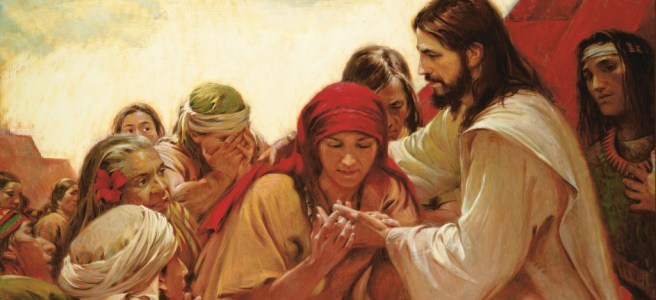
Blessed are the Meek, For They Shall Inherit the Earth

Jesus Christ taught the descendants of Lehi in the Americas (who were of the house of Israel) many of the same principles He taught to His Jewish disciples in the Old World. The teachings as recorded in the book of Matthew, found in the New Testament, known as the Beatitudes (Matthew 5:1-12) were again taught by the Savior when he visited Lehi’s descendants.

Below is the third of the Beatitudes, as recorded in the King James version of Matthew, and the comparable teaching as found in 3 Nephi of the Book of Mormon.

Blessed are the meek: for they shall inherit the earth.” (Matthew 5:5)

And blessed are the meek, for they shall inherit the earth.” (3 Nephi 12:5)

Questions:

-How much of the pain and suffering in the interpersonal affairs of humanity is caused by those who are the opposite of meek (god-despising, unprincipled, prideful, arrogant, impatient, dismissive of gospel teachings)?

-Will any of the above (who don’t repent) be a part of the beautiful society that will exist upon the Earth after it is celestialized?

Blessed Are They That Mourn, For They Shall Be Comforted

Jesus Christ taught the descendants of Lehi in the Americas (who were of the house of Israel) many of the same principles He taught to His Jewish disciples in the Old World. The teachings as recorded in the book of Matthew, found in the New Testament, known as the Beatitudes (Matthew 5:1-12) were again taught by the Savior when he visited Lehi’s descendants.

Below is the second of the Beatitudes, as recorded in the King James version of Matthew, and the comparable teaching as found in 3 Nephi of the Book of Mormon.

Blessed are they that mourn: for they shall be comforted.” (Matthew 5:4)

And again, blessed are all they that mourn, for they shall be comforted.” (3 Nephi 12:4)

Questions:

-Do the pains and disappointments of this life provide the context in which the joys and blessings of heaven are deeply appreciated and valued (for eternity)?

Blessed Are the Poor in Spirit Who Come unto Me

Jesus Christ taught the descendants of Lehi in the Americas (who were of the house of Israel) many of the same principles He taught to His Jewish disciples in the Old World. The teachings as recorded in the book of Matthew, found in the New Testament, known as the Beatitudes (Matthew 5:1-12) were again taught by the Savior when he visited Lehi’s descendants.

Below is the first of the Beatitudes, as recorded in the King James version of Matthew, and the comparable teaching as found in 3 Nephi of the Book of Mormon.  

“Blessed are the poor in spirit: for theirs is the kingdom of heaven” (Matthew 5:3)

Yea, blessed are the poor in spirit who come unto me, for theirs is the kingdom of heaven.” (3 Nephi 12:3)

Questions:

-Why would God inspire Joseph Smith to interpret the Beatitudes – as taught by Christ to Lehi’s descendants in the Americas — in language very similar to the King James version of the Bible?

-Do you feel the phrase, “who come unto me,” is an inspired addition to what is found in Matthew.

-What does it mean to be poor in spirit?

-Is it possible to truly come unto Christ if one is not poor in spirit?

Satan Goes About Spreading Rumors and Contentions That He Might Harden the Hearts of the People

The Book of Mormon gives insight into how Satan works to destroy civilizations and societies.

“…The people [did] imagine up in their hearts [many] things which were foolish and vain; and they were much disturbed, for Satan did stir them up to do iniquity continually; yea, he did go about spreading rumors and contentions upon all the face of the land, that he might harden the hearts of the people against that which was good…” (Helaman 16:22)

Questions:

-How much of what people believe is based on rumors?

-Do the main players in the news media of the United States align themselves with the truth? Or, are they more focused on ratings and political expedients?

-Have many aligned their hearts with things that are untrue, foolish, and vain?

-How much unnecessary contention is occurring because hearts are connected to rumors and falsehoods.

The Devil Will Not Support His Children

Mormon, the prophet who compiled and abridged the record of the Nephites (which was translated as the Book of Mormon), pauses to teach an important truth about Satan.

“…The devil will not support his children at the last day, but doth speedily drag them down to hell.” (Alma 30:60)

Questions:

-Is it possible to gain power and gratify the lusts of the flesh in this life by being a child of the devil (e.g. rejecting God’s commandments and applying selfish, calloused, and ungodly means to obtain one’s desires)?

*Does Satan goad souls to take this route because he enjoys seeing the selfish pleasure they obtain for a season?

*Or, does he do so because he relishes the awful depths of eternal remorse and pain that they will sink into when, after being brought into God’s presence for judgment, they come to a full and agonizing realization of the consequences of what they have done.

How Great the Inequality of Man

During a large war between the Nephites and Lamanites, many souls departed from mortal life. In the context of these events, Mormon (the prophet-historian who abridged the Nephite record that was translated as the Book of Mormon), teaches about the great spiritual variance that exists when souls pass through the veil into the eternities.

“…Many thousand are mourning for the loss of their kindred, because they have reason to fear, according to the promises of the Lord, that they are consigned to a state of endless wo. While many thousands of others truly mourn for the loss of their kindred, yet they rejoice and exult in the hope, and even know, according to the promises of the Lord, that they are raised to dwell at the right hand of God, in a state of never-ending happiness. And thus we see how great the inequality of man is because of sin and transgression, and the power of the devil, which comes by the cunning plans which he hath devised to ensnare the hearts of men.” (Alma 28:11-13)

Questions:

-How important is it to repent and reconcile oneself with God (through the Atonement of Jesus Christ) before passing into the eternities?

-How heavily will the unalterable justice, which God upholds, weigh on those in the afterlife who chose not to be reconciled with God through Christ’s merciful intervention during mortality?

-What is Paradise?

-What is Spirit Prison?

-Will those who never had God’s law in mortality be led to Paradise if they choose to follow Christ in the afterlife?

Their State Becomes Worse Than if They Had Never Known the Spirit of God and Righteousness

The prophet-historian Mormon, who abridged the Nephite records into what would be translated as the Book of Mormon, pauses during his historical narrative to teach an important truth about the fate of those who know the truth and then reject it.

He describes how former Nephites, who once had the gospel but then rejected it and joined the Lamanites (the Nephite’s enemies), were more murderous than the Lamanites who had never had the truth of the gospel. This was demonstrated when the Lamanite army came upon a group of unarmed, non-resisting people and the former Nephites among the Lamanite army killed many more non-combatants compared with those in the army who had always been Lamanites. (Alma 24:20-30)

“…After a people have been once enlightened by the Spirit of God, and have had great knowledge of things pertaining to righteousness, and then have fallen away into sin and transgression, they become more hardened, and thus their state becomes worse than though they had never known these things.” (Alma 24:30)

Questions:

-Why would those who once had the Spirit of God, and then reject that Spirit, fall into deeper levels of sin than they would have if they had never known the truth of God?

-Who in the world today has had an abundance of God’s Spirit? Do they have the potential to become more hardened against God than others who haven’t had that abundance (depending on their choices)?

If Our First Parents Could Have Partaken of the Tree of Life (After Partaking of the Forbidden Fruit) They Would Have Been Forever Miserable

The Book of Mormon prophets affirm that Adam and Eve were real people. Their fall brought death (physical and spiritual) into the world, but God knew this would happen. His plan utilized the mortal life that occurred because of the Fall to give His spiritual children (all of us on Earth) experience we could have gained no other way. He then provided a Savior, Jesus Christ, to overcome physical death for all and provide an escape from spiritual death for those who choose to follow Christ.

The verses below teach that immortality is a curse without the healing power of Christ’s Atonement.

Adam did fall by the partaking of the forbidden fruit, according to the word of God; and thus we see, that by his fall, all mankind became a lost and fallen people. And now behold, I say unto you that if it had been possible for Adam to have partaken of the fruit of the tree of life at that time, there would have been no death, and the word of God would have been void…” (Alma 12:22-23)

“And now behold, if it were possible that our first parents could have gone forth and partaken of the tree of life they would have been forever miserable, having no preparatory state; and thus the plan of salvation would have been frustrated…but behold it was not so; but it was appointed unto men that they must die; and after death, they must come to judgment…” (Alma 12:26-27)

Questions:

-Are some still seeking the “tree of life” in our time?

-How likely is it that God would allow His children to obtain immortality if it would be a curse to them?

-Are cherubim with a flaming sword, figuratively speaking, still guarding the tree of life (if the tree of life represents immortality separate from that provided through Christ’s Atonement)? (see Genesis 3:24)

This is My Church

Alma, the Nephite prophet, was troubled by members of the Lord’s church who were committing sin and not repenting. He was hesitant to take action because he didn’t want to judge them wrongly in the Lord’s eyes, but felt that action needed to be taken. As he prayed, the Lord revealed the following to him:

“…He that will hear my voice shall be my sheep; and him shall ye receive into the church, and him will I also receive. For behold, this is my church; whosoever is baptized shall be baptized unto repentance. And whomever ye receive shall believe in my name; and him will I freely forgive. For it is I that taketh upon me the sins of the world; for it is I that hath created them; and it is I that granteth unto him that believeth unto the end a place at my right hand. For behold, in my name are they called; and if they know me they shall come forth, and shall have a place eternally at my right hand.” (Mosiah 26:21-24)

“And it shall come to pass that when the second trump shall sound then shall they that never knew me come forth and shall stand before me. And then shall they know that I am the Lord their God, that I am their Redeemer; but they would not be redeemed. And then I will confess unto them that I never knew them; and they shall depart into everlasting fire prepared for the devil and his angels. Therefore I say unto you, that he that will not hear my voice, the same shall ye not receive into my church, for him I will not receive at the last day.” (Mosiah 26:25-28)

Questions:

-Is the Book of Mormon the Lord’s voice?

-Is the Bible the Lord’s voice?

-Is it possible to heed some of the Lord’s words but ignore others?

-Does the phrase “never knew me” in the passage above suggest that only those who never listened to the Lord’s voice will “depart into everlasting fire?” How rare is it to find a person who never listened to the voice of the Lord?

-How important is it to strive to listen to all that the Lord speaks versus listening selectively?

The Lord Seeth Fit to Chasten His People

After finding a new place to settle, a group of Nephites — who were keeping God’s commandments and living peaceably with one another – were taken captive by their enemies the Lamanites. The prophet Mormon (who abridged and made important observations within the text of the Book of Mormon) describes why the Lord allowed this to happen.

“…The Lord seeth fit to chasten his people; yea, he trieth their patience and their faith. Nevertheless—whosoever putteth his trust in him the same shall be lifted up at the last day.” (Mosiah 23:21-22)

Questions:

-Does anyone escape chastening by God? Or, is this life constructed by God to chasten?

-Are the people of God (those who have the true priesthood and are striving to love God and their neighbor as themselves) more likely to be chastened? Or, are they less likely to be chastened?

-Does trust in God, through trial, purify and sanctify the soul?