If Ye Enter in by the Way, and Receive the Holy Ghost, It Will Show You All Things What Ye Should Do

Nephi declares that God grants spiritual understanding, to those who sincerely seek it, through the Holy Ghost.

“…After I have spoken these words, if ye cannot understand them it will be because ye ask not, neither do ye knock; wherefore, ye are not brought into the light, but must perish in the dark. For behold, again I say unto you that if ye will enter in by the way, and receive the Holy Ghost, it will show unto you all things what ye should do.” (2 Nephi 32:4-5)

Questions:

-What is the best way to ask for spiritual understanding? Is it as simple as saying a sincere prayer and asking God?

-How many who read the teachings contained within the Book of Mormon are willing to take this step to sincerely pray for understanding and seek a confirmation of the truth from the Holy Ghost?

Feast upon the Words of Christ

Nephi teaches that angels speak by the power of the Holy Ghost and mortals who receive the Holy Ghost can speak by the same power.

“Do you not remember that I said unto you that after ye had received the Holy Ghost ye could speak with the tongue of angels? And now, how could ye speak with the tongue of angels save it were by the Holy Ghost? Angels speak by the power of the Holy Ghost; wherefore, they speak the words of Christ. Wherefore, I said unto you, feast upon the words of Christ; for behold, the words of Christ will tell you all things what ye should do.” (2 Nephi 32:2-3)

Questions:

-Who is speaking by the power of the Holy Ghost today?

-Where can one go to feast upon the words of Christ?

Has the Lord called prophets in our time to teach us and guide us?

-If you had the opportunity to hear someone speak with the tongue of an angel, to what lengths would you go to take advantage of that opportunity?

-Can only a prophet speak by the power of the Holy Ghost? What qualifies one to speak by the power of the Holy Ghost?

Teachings of Latter-day Prophets, Seers, and Revelators:

“To feast means more than to taste. To feast means to savor. We savor the scriptures by studying them in a spirit of delightful discovery and faithful obedience. When we feast upon the words of Christ, they are embedded ‘in fleshy tables of the heart’ [2 Corinthians 3:3]. They become an integral part of our nature” (Russell M. Nelson, “Living by Scriptural Guidance,” Ensign, Nov. 2000, 17).

“If you and I are to feast upon the words of Christ, we must study the scriptures and absorb His words through pondering them and making them a part of every thought and action” (Robert D. Hales, “Healing Soul and Body,” Ensign, Nov. 1998, 15).

“I find that when I get casual in my relationships with divinity and when it seems that no divine ear is listening and no divine voice is speaking, that I am far, far away. If I immerse myself in the scriptures the distance narrows and the spirituality returns” (Teachings of Spencer W. Kimball, 135)

Do the Things Which I Have Told You I Have Seen That Your Lord and Your Redeemer Should Do

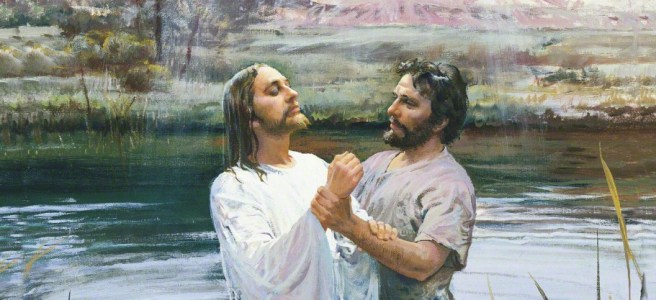
After teaching about the baptism of Christ and the importance of baptism for all of God’s children, Nephi teaches about how a person should move forward after being baptized.

“Wherefore, do the things which I have told you I have seen that your Lord and your Redeemer should do; for, for this cause have they been shown unto me, that ye might know the gate by which ye should enter. For the gate by which ye should enter is repentance and baptism by water; and then cometh a remission of your sins by fire and by the Holy Ghost. And then are ye in this strait and narrow path which leads to eternal life; yea, ye have done according to the commandments of the Father and the Son; and ye have received the Holy Ghost, which witnesses of the Father and of the Son, unto the fulfilling of the promise which he hath made, that if ye entered in by the way ye should receive.” (2 Nephi 31:17-18)

“And now my beloved brethren, after ye have gotten into this strait and narrow path, I would ask if all is done? Behold, I say unto you, Nay; for ye have not come thus far save it were by the word of Christ with unshaken faith in him, relying wholly upon the merits of him who is mighty to save. Wherefore, ye must press forward with a steadfastness in Christ, having a perfect brightness of hope, and a love of God and of all men. Wherefore, if ye shall press forward, feasting upon the word of Christ, and endure to the end, behold, thus saith the Father: Ye shall have eternal life.” (2 Nephi 31:19-20)

“And now, behold, my beloved brethren, this is the way; and there is none other way nor name given under heaven whereby man can be saved in the kingdom of God. And now, behold, this is the doctrine of Christ, and the only and true doctrine of the Father, and of the Son and of the Holy Ghost, which is one God, without end. Amen.” (2 Nephi 31:21)

Questions:

-How many knew about the necessity of baptism before Christ came to the earth?

-Did others, besides the Nephites, who were of the house of Israel practice baptism before the ministry of John the Baptist?

-Was the idea of baptism completely new to the Jewish people when John the Baptist began his ministry?

-Is there any reason to doubt Christ’s power to save your soul in the kingdom of God if you press forward after baptism as described in the verses above?

Teachings of Latter-day Prophets, Seers, and Revelators:

“Sins are remitted not in the waters of baptism, as we say in speaking figuratively, but when we receive the Holy Ghost. … We become clean when we actually receive the fellowship and companionship of the Holy Ghost. It is then that sin and dross and evil are burned out of our souls as though by fire. The baptism of the Holy Ghost is the baptism of fire” (Bruce R. McConkie, A New Witness for the Articles of Faith [1985], 290).

“The ‘doctrine of Christ’ as taught by Nephi in his grand, summational discourse focuses on faith in the Lord Jesus Christ, repentance, baptism by immersion, receiving the gift of the Holy Ghost, and enduring to the end. It does not, in this declaration, attempt to cover the entire plan of salvation, all the virtues of a Christian life, or the rewards that await us in differing degrees of heavenly glory. It does not, in this declaration, deal with the offices of the priesthood, the ordinances of the temple, or many other true doctrines. All these are important, but as used in the Book of Mormon, ‘the doctrine of Christ’ is simple and direct. It focuses on the first principles of the gospel exclusively, including an expression of encouragement to endure, to persist, to press on. Indeed, it is in the clarity and simplicity of ‘the doctrine of Christ’ that its impact is found. Nephi knew it would be so. He wrote, ‘I shall speak unto you plainly, according to the plainness of my prophesying’ [2 Nephi 31:2]” (Jeffrey R. Holland, Christ and the New Covenant: The Messianic Message of the Book of Mormon [1997], 49–50).

“The Holy Ghost provides personal revelation to help us make major life decisions about such things as education, missions, careers, marriage, children, where we will live with our families, and so on. …

“… As the scriptures attest, the Holy Ghost also testifies of the Savior and God the Father [see John 15:26; Romans 8:16]. He teaches us ‘the peaceable things of the kingdom’ [D&C 39:6] and causes us to ‘abound in hope’ [Romans 15:13]. He ‘leadeth [us] to do good … [and] to judge righteously’ [D&C 11:12]. He gives ‘to every man [and woman] … a [spiritual] gift … that all may be profited thereby’ [D&C 46:11–12; see also Moroni 10:8–17; D&C 13–16]. He ‘giveth [us] knowledge’ [Alma 18:35] and ‘bring[s] all things to [our] remembrance’ [John 14:26]. Through the Holy Ghost, we ‘may be sanctified’ [3 Nephi 27:20] and receive ‘a remission of [our] sins’ [2 Nephi 31:17]. He is the ‘Comforter,’ the same who was ‘promised unto [the Savior’s] disciples’ [D&C 88:3]” (Robert D. Hales, “The Holy Ghost,” Ensign or Liahona, May 2016, 105).

“The only measure of true greatness is how close a man can become like Jesus. The man is greatest who is most like Christ, and those who love him most will be most like him.” (Ezra Taft Benson, “Listen to a Prophet’s Voice,” 57)



He That Endureth to the End, the Same Shall Be Saved

The prophet Nephi shares the revelation he received regarding the importance of remaining faithful (in thought and deed) in this life after entering the baptismal covenant and receiving the Holy Ghost.

“…Thus came the voice of the Son unto me, saying: After ye have repented of your sins, and witnessed unto the Father that ye are willing to keep my commandments, by the baptism of water, and have received the baptism of fire and of the Holy Ghost, and can speak with a new tongue, ye, even with the tongue of angels, and after this should deny me, it would have been better for you that ye had not known me. And I heard a voice from the Father, saying: Yea, the words of my Beloved are true and faithful. He that endureth to the end, the same shall be saved.” (2 Nephi 31:14-15)

“And now, my beloved brethren, I know by this that unless a man shall endure to the end, in following the example of the Son of the living God, he cannot be saved.” (2 Nephi 31:16)

Questions:

-What does it mean to endure to the end?

-Why do some fail to finish what they started after entering the baptismal covenant and receiving a witness from the Holy Ghost?

-How easy is it to question the witness of the Holy Ghost received early on, when later one does not have the same level of the Spirit’s purifying influence in his or her life?

-What can cause the influence of the Spirit to diminish over time?

-How quickly can one regain the full influence of the Spirit after repenting and recommitting to follow Jesus Christ? Is the amount of time needed to regain the Spirit’s strong influence connected to how far from the Spirit a person has drifted?

-Does any of the above apply to those who are baptized by someone who does not have God’s authority to do so?

Teachings of Latter-day Prophets, Seers, and Revelators:

“Enduring to the end is the doctrine of continuing on the path leading to eternal life after one has entered into the path through faith, repentance, baptism, and receiving the Holy Ghost. Enduring to the end requires our whole heart or, as the Book of Mormon prophet Amaleki teaches, we must ‘come unto him, and offer [our] whole souls as an offering unto him, and continue in fasting and praying, and endure to the end; and as the Lord liveth [we] will be saved’ [Omni 1:26].

“Enduring to the end means that we have planted our lives firmly on gospel soil, staying in the mainstream of the Church, humbly serving our fellow men, living Christlike lives, and keeping our covenants. Those who endure are balanced, consistent, humble, constantly improving, and without guile. Their testimony is not based on worldly reasons—it is based on truth, knowledge, experience, and the Spirit” (Joseph B. Wirthlin, “Press On,” Ensign or Liahona, Nov. 2004, 101).

He That Is Baptized in My Name, to Him Will the Father Give the Holy Ghost

Nephi continues to teach about baptism and receiving the Holy Ghost.

“…The voice of the Son came unto me, saying: He that is baptized in my name, to him will the Father give the Holy Ghost, like unto me; wherefore, follow me, and do the things which ye have seen me do.” (2 Nephi 31:12)

“Wherefore my beloved brethren, I know that if ye shall follow the Son with full purpose of heart, acting no hypocrisy and no deception before God, but with real intent, repenting of your sins, witnessing unto the Father that ye are willing to take upon you the name of Christ, by baptism—yea, by following your Lord and your Savior down into the water, according to his word, behold, then shall ye receive the Holy Ghost; yea, then cometh the baptism of fire and of the Holy Ghost; and then can ye speak with the tongue of angels, and shout praises unto the Holy One of Israel.” (2 Nephi 31:13)

Questions:

-Is it possible to be baptized, by one who holds authority to do so by God, and still not receive the Holy Ghost? Why would the Holy Ghost’s influence be muted or absent?

-How important is it for a person to enter the waters of baptism with a repentant heart and a sincere will to serve the Father by following Christ?

-Why might a person be tempted to enter the waters of baptism with less than pure motives?

-What is the baptism of fire that occurs if a person does enter into a true baptismal covenant with pure motives?

-Is the baptism of fire always a dramatic experience? Whether “dramatic” is the right word or not, is it always an exceptional experience? Does the fire burn differently for different people (depending on their personality and circumstances)? How often does one need the purifying effect of the Spirit’s fire to stay the course in following Christ?

-What does it sound like when someone speaks with the tongue of an angel?

Teachings of Latter-day Prophets, Seers, and Revelators:

“The ordinance of confirming a new member of the Church and bestowing the gift of the Holy Ghost is both simple and profound. Worthy Melchizedek Priesthood holders place their hands upon the head of an individual and call him or her by name. Then, by the authority of the holy priesthood and in the name of the Savior, the individual is confirmed a member of The Church of Jesus Christ of Latter-day Saints, and this important phrase is uttered: ‘Receive the Holy Ghost.’

“The simplicity of this ordinance may cause us to overlook its significance. These four words—‘Receive the Holy Ghost’—are not a passive pronouncement; rather, they constitute a priesthood injunction—an authoritative admonition to act and not simply to be acted upon (see 2 Nephi 2:26). The Holy Ghost does not become operative in our lives merely because hands are placed upon our heads and those four important words are spoken. As we receive this ordinance, each of us accepts a sacred and ongoing responsibility to desire, to seek, to work, and to so live that we indeed ‘receive the Holy Ghost’ and its attendant spiritual gifts. …

“Praying, studying, gathering, worshipping, serving, and obeying are not isolated and independent items on a lengthy gospel checklist of things to do. Rather, each of these righteous practices is an important element in an overarching spiritual quest to fulfill the mandate to receive the Holy Ghost. The commandments from God we obey and the inspired counsel from Church leaders we follow principally focus upon obtaining the companionship of the Spirit. Fundamentally, all gospel teachings and activities are centered on coming unto Christ by receiving the Holy Ghost in our lives” (David A. Bednar, “Receive the Holy Ghost,” Ensign or Liahona, Nov. 2010, 95, 97).


“We are commanded and instructed to so live that our fallen nature is changed through the sanctifying power of the Holy Ghost. President Marion G. Romney taught that the baptism of fire by the Holy Ghost ‘converts [us] from carnality to spirituality. It cleanses, heals, and purifies the soul. … Faith in the Lord Jesus Christ, repentance, and water baptism are all preliminary and prerequisite to it, but [the baptism of fire] is the consummation. To receive [this baptism of fire] is to have one’s garments washed in the atoning blood of Jesus Christ’ (Learning for the Eternities, comp. George J. Romney [1977], 133; see also 3 Nephi 27:19–20).

“Hence, as we are born again and strive to always have His Spirit to be with us, the Holy Ghost sanctifies and refines our souls as if by fire (see 2 Nephi 31:13–14, 17). Ultimately, we are to stand spotless before God” (“Clean Hands and a Pure Heart,” Ensign or Liahona, Nov. 2007, 81).

Repent Ye and Be Baptized in the Name of My Beloved Son

The prophet Nephi received a vision (sometime around 600 B.C.) of the future baptism of Christ and teaches about its significance.

“…If the Lamb of God, he being holy, should have need to be baptized by water, to fulfill all righteousness, O then, how much more need have we, being unholy, to be baptized, yea, even by water! And now, I would ask of you my beloved brethren, wherein the Lamb of God did fulfil all righteousness in being baptized by water? Know ye not that he was holy? But notwithstanding he being holy, he showeth unto the children of men that, according to the flesh he humbleth himself before the Father that he would be obedient unto him in keeping his commandments. (2 Nephi 31:5-7)

And again, it showeth unto the children of men the straitness of the path, and the narrowness of the gate, by which they should enter, he having set the example before them. And he said unto the children of men: Follow thou me. Wherefore, my beloved brethren, can we follow Jesus save we shall be willing to keep the commandments of the Father? And the Father said: Repent ye, repent ye, and be baptized in the name of my Beloved Son. (2 Nephi 31:9-11)

Questions:

-If Christ was compliant with God’s commandment to be baptized, how important is it for all others who have lived on the earth to be baptized as well?

-Is a baptism valid in God’s eyes if the person doing the baptism does not have the proper priesthood authority?

-Who has the authority to baptize?

-What will happen to all those who never had a chance to be baptized during their lifetime?

-Would a just God deny them the blessings of being baptized if they never had the chance to do so?

How can all those who died without baptism receive it according to the Father’s commandment?

The Lord God Giveth Light unto the Understanding

Nephi describes some of the qualities of God’s communication with His children on earth:

“…My soul delighteth in plainness; for after this manner doth the Lord God work among the children of men. For the Lord God giveth light unto the understanding; for he speaketh unto men according to their language, unto their understanding” (2 Nephi 31:3)

Questions:

-Why does God use plainness in His interactions with mortals? If He didn’t use plainness, would only those with “superior” intellects be able to understand God? As it is, is there anyone who cannot understand God’s messages?

-How are God’s messages conveyed to you? Do others receive His messages differently?

-How does God give light unto the understanding?

-Why does God use the specificity of the earth’s languages rather than only relying on the ineffable witnesses of the Spirit?

There is Nothing Which is Secret Save It Shall be Revealed

After quoting a passage from Isaiah’s writings (comparable to those found in the King James Version of Isaiah 11:5-9) describing the peace that will reign during the Millennium, Nephi expands on the meaning of Isaiah’s words found in verse 9 of chapter 11:

“…The things of all nations shall be made known; yea all things shall be made known unto the children of men. There is nothing which is secret save it shall be revealed; there is no work of darkness save it shall be made manifest in the light; and there is nothing which is sealed upon the earth save it shall be loosed. Wherefore, all things which have been revealed unto the children of men shall at that day be revealed; and Satan shall have power over the hearts of the children of men no more for a long time…” (2 Nephi 30:16-18)

Questions:

-Why will all of history be accurately revealed during Christ’s Millennial reign?

-Why will everything that has ever been revealed to mankind be brought together and revealed anew during the Millennium?

-What is the relationship between the people having this knowledge/revelation and Satan being bound?

Teachings of Latter-day Prophets, Seers, and Revelators:

“We talk about Satan being bound. Satan will be bound by the power of God; but he will be bound also by the determination of the people of God not to listen to him, not to be governed by him” (George Q. Cannon, in Conference Report, Oct. 1897, 65).

The Lord God Shall Cause a Great Division among the People

Nephi prophesies about the great division that will occur among the inhabitants of the earth as the Lord gathers the house of Israel out of all lands and peoples during the last days.

“…It shall come to pass that the Lord God shall commence his work among all nations, kindreds, tongues, and people, to bring about the restoration of his people upon the earth. And with righteousness shall the Lord God judge the poor, and reprove with equity for the meek of the earth. And he shall smite the earth with the rod of his mouth; and with the breath of his lips shall he slay the wicked. For the time speedily cometh that the Lord God shall cause a great division among the people, and the wicked will he destroy; and he will spare his people, yea, even if it so be that he must destroy the wicked by fire.”  (2 Nephi 30:8-10)

Questions:

-Who are the Lord’s people?

-According to these versus, what kind of person will the Lord help and protect as wickedness grows around the world?

-Will the kind of people the Lord will protect and gather during the last days take joy in seeing the wicked suffer? Are those who are humble and meek likely to have ill will towards others and have a vengeful spirit?

-Would God destroy the wicked other than to spare His people?

-Does God reprove anyone who is willing to repent and come to his Son, Jesus Christ (regardless of whether they are of the house of Israel or not)?

Teachings of Latter-day Prophets, Seers, and Revelators:

“I testify that as the forces of evil increase under Lucifer’s leadership and as the forces of good increase under the leadership of Jesus Christ, there will be growing battles between the two until the final confrontation. As the issues become clearer and more obvious, all mankind will eventually be required to align themselves either for the kingdom of God or for the kingdom of the devil. As these conflicts rage, either secretly or openly, the righteous will be tested. God’s wrath will soon shake the nations of the earth and will be poured out on the wicked without measure. (See JS—H 1:45; D&C 1:9.)” (Ezra Taft Benson, “I Testify,” Ensign, Nov. 1988, 87).

Then Shall the Remnant of Our Seed Know Concerning Us

Nephi prophesies that his and his father’s descendants would begin to receive and believe in the Book of Mormon over a relatively small number of generations after its publication.

“And now, I would prophesy somewhat more concerning the Jews and the Gentiles. For after the book of which I have spoken shall come forth, and be written unto the Gentiles, and sealed up again unto the Lord, there shall be many which shall believe the words which are written; and they shall carry them forth unto the remnant of our seed. And then shall the remnant of our seed know concerning us, how that we came out from Jerusalem, and that they are descendants of the Jews. And the gospel of Jesus Christ shall be declared among them; wherefore, they shall be restored unto the knowledge of their fathers, and also to the knowledge of Jesus Christ, which was had among their fathers.” (2 Nephi 30:3-5)

“And then shall they rejoice; for they shall know that it is a blessing unto them from the hand of God; and their scales of darkness shall begin to fall from their eyes; and many generations shall not pass away among them, save they shall be a pure and a delightsome people. And it shall come to pass that the Jews which are scattered also shall begin to gather in upon the face of the land; and as many as shall believe in Christ shall also become a delightsome people.” (2 Nephi 30:6-7)

Questions:

-Are Lehi’s descendants beginning to believe the words that are written in the Book of Mormon?

Video:
//players.brightcove.net/710874264001/default_default/index.html?videoId=5789331030001